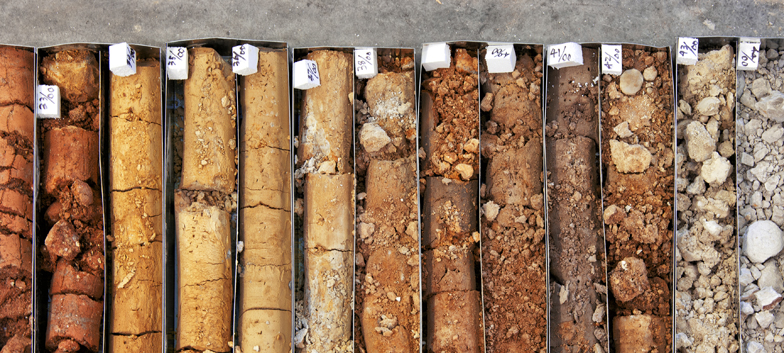
1. What is SPT?
The standard penetration test is a leading test in Soil Exploration (Soil Investigation) performed on the field (In-situ) and designed to provide information on the geotechnical engineering properties of soil. The test procedure is described in ISO 22476-3.
SPT gives us the Standard Penetration Number (SPN).
2. How to Perform SPT?
On field, we basically use three types of sampler to take the representative sample. The sample may be Disturbed* or Undisturbed**, basing on the type of sampler used.
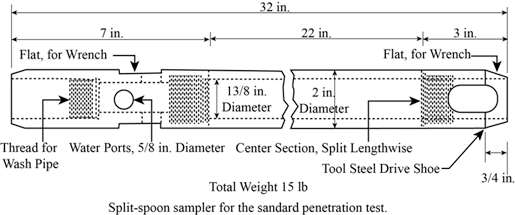
2.1. Split-spoon Sampler: This is the most common type of sampler that is used in the field to get SPN. It gives disturbed but representative sample for soil investigation.
Image Credit: chegg.com
2.2. Open Drive Sampler: This is rarely used on the field and it is used to take clayey representative Undisturbed sample.
2.3. Piston Sampler: The function of this sampler is almost the same as open drive sampler and rarely used on the field.
3.Various Ratios of Sampler
A standard sampler has two main parts. The first one is Steel Driving Cutting shoe and the rest one is Cylindrical Tube. The digging element of a sampler is the Metal Drill Rod, present inside the Cylindrical tube and it’s removable.
- INSIDE CLEARANCE RATIO(CI): It allows elastic expansion of the sample and reduces frictional drag. For Undisturbed sample it should lie in the range of 0.5 – 3%. And CI is generally 1-3% of D
- OUTSIDE CLEARANCE RATIO(CO): For undisturbed sample it should lie between 0 – 2%. CO is much greater than CI.
- AREA RATIO(Ar): The thin wall tube, which is normally formed from 1/16 to 1/8-inch metal is drawn in at the lower end and is reamed so that the inside diameter of the cutting edge is 5 to 1.5 % less than that of the inside diameter of the tube. The exact percentage is governed by the size and wall thickness of the tube. The wall thickness is governed by the Area Ratio.
- RECOVERY RATIO(Rr): This is the percentage ratio between the length of the core recovered and the length of the core drilled on a given rod.
3.1. This is a type of sample tube and its dimensions are provided to calculate the various ratios :
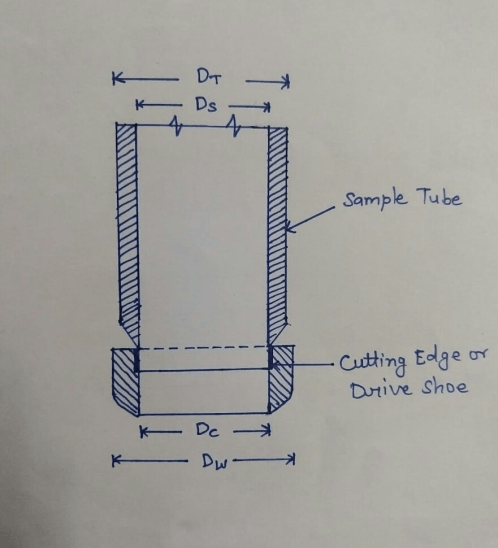
3.2. Various ratios, formula, and the expected value is given in the table
| Various Ratio | Formula | Expected Value |
| Inside Clearance Ratio (CI) | (DS – DC) / DC | 0.5 – 3% |
| Outside Clearance Ratio (CO) | (DW – DT) / DT | 0 – 2% |
| Area Ratio (Ar) | (DW2 – DC2) / DC2 | ≤ 20% (stiff Clay)
≤ 10% (Soft Sensitive Clay) |
| Recovery Ratio (Rr) | L/H | 96 – 98% |
Difference between Disturbed and Undisturbed Sample :
| Disturbed Sample | Undisturbed Sample |
| Disturbed samples are taken from cuttings produced by the drilling process. | Undisturbed samples are generally taken by cutting blocks of soil or rock, or by pushing or driving tubes into the ground. |
| Disturbed samples are used to perform some general tests of soil like Gradation of soil, consistency of soil and Stratification of soil. | Undisturbed samples are used to perform some advance tests of soil like Compressibility of soil, strength of soil, Moisture content of soil, unit weight of soil. |
4. How to Calculate SPN(N60)?
These are the following steps which we used to calculate the standard penetration number
- First of all, the borehole is drilled to a required depth and clean the bottom of the borehole.
- Split-spoon sampler is attached to the drill rods and lowered into the borehole until it touches the bottom.
- The hammer which has a standard weight of 63.5 Kg is dropped vertically from a height, 750 mm and the standard rate is 30 blows/minute.
- The number of blows is recorded for the first 150 mm sampler penetration and this recorded value has zero contribution towards the SPN.
- Then the number of blows is recorded for the next two successive 150 mm sampler penetration and these recorded values are added to give the standard penetration number(N60).
- If the SPN value is more than 50, the SPN is not taken under consideration and the above process is repeated again to obtain the proper SPN value
5. Correction in N60
The recorded value of SPN, donated by N60 has two types of error. These are Dilatancy Error (DE) and Overburden Pressure Error (OPE). The way of correcting these two errors are explained below-
5.1. Overburden Pressure Correction – Due to this error, the soil of same density will give smaller blow counts near the ground surface. The overburden stress normalization parameter (CN) can be used for correction for this factor.
N’60 = CNN60
CN: Correction factor
N’60: Intermediate Corrected SPN
N60: Recorded SPN
5.2. Empirical Relationship for CN
(σ’0 is the Overburden Pressure in kN/m2)
| SOURCE | CN |
| Liao and Whitman (1986) | 9.780
|
| Skempton (1986) |
2/ (1+0.01 σ’0) |
| Seed et al. (1975)
|
1 – 1.25log(σ’0/95.6) |
| Peek et al. (1974) | 0.77log (1912/ σ’0)
For σ’0 ≥ 25 kN/m2
|
5.2. Dilatancy Correction- After applying Overburden Pressure Correction on Recorded SPN, the Dilatancy correction is applied if N’60 exceeds 15.
N”60=15+0.5(N’60 -15) If N’60>15
N”60 =N’60 If N’60≤15
N”60: Final Corrected SPN

 EDUCATION ONLINE